



A Spoonful of Sunlight: What Real Olive Oil Does Inside Your Body
There is a moment, when you taste a truly fresh extra virgin olive oil, that tells you almost everything you need to know about it. A slight bitterness at the front. Then, a second or two later, a peppery sting at the back of the throat, sharp enough to make you cough. Most people assume that catch in the throat is a flaw. It is the opposite. That sting is the taste of medicine.
As a physician, I find this a useful place to start, because it is the most honest way to understand olive oil. Long before laboratories and health claims, the people of the Mediterranean already knew, in their bodies, that good oil was good for them. They built entire cuisines and long lives around it. Modern science has simply caught up and given names to what the throat already recognised.
What follows is not a miracle story. Olive oil is not a cure for anything. But it is one of the few foods where the everyday wisdom, the molecular chemistry, and the large clinical trials all point in the same direction, and that is rare enough to be worth understanding properly.
The molecule behind the sting
In 2005, a researcher named Gary Beauchamp noticed that the throat-catch from a fresh Sicilian olive oil felt oddly familiar. It reminded him of liquid ibuprofen, which produces the same irritation in exactly the same spot. He was, at the time, studying the taste of ibuprofen itself. That hunch turned into a landmark study published in Nature.
The compound responsible is called oleocanthal. And it does not just feel like ibuprofen, it behaves like it. Oleocanthal blocks the same inflammatory enzymes, COX-1 and COX-2, that anti-inflammatory drugs target. Not as a metaphor, but measurably, in the same way, in the same laboratory tests.
This matters because chronic, low-grade inflammation sits quietly beneath most of the diseases we treat as we age: heart disease, stiff joints, metabolic trouble, even cognitive decline. A daily spoonful of an oil rich in oleocanthal is, in a small but real sense, a gentle anti-inflammatory dose that arrives with food, instead of from a pill bottle. To be clear: it is far weaker than a tablet, and it will not replace medication where medication is genuinely needed. But as a daily habit, sustained over years, the direction of travel is the right one, and unlike a drug, it comes with no stomach lining to worry about and a great deal of pleasure attached.
Here is the catch, though. Oleocanthal is fragile. It is highest in oil that is genuinely fresh, cold-pressed soon after harvest, and made from olives that were not left to over-ripen. Sit oil in heat and light for a year and that sting, and the protection behind it, fades. This is precisely why how an oil is made, and how fresh it is, is not a detail. A cheap, stale, refined oil and a fresh, well-made extra virgin oil are, biologically, almost two different foods.
Polyphenols: the body’s antioxidant ally
Oleocanthal belongs to a larger family of protective compounds called polyphenols, the same molecules that give real extra virgin olive oil its bitterness, its colour, and its character. Two of the most studied are hydroxytyrosol and oleuropein.
Their job, simply put, is to defend your cells from oxidation, the slow internal “rusting” that damages tissues over time. One target is especially important: your LDL cholesterol. LDL only becomes dangerous to your arteries once it has been oxidised. Olive oil polyphenols help shield those particles from that damage, which is one of the mechanisms by which the oil protects the cardiovascular system.
This is not a soft claim. It is one of the very few food-and-health statements officially approved by the European Food Safety Authority. The wording is precise: olive oil polyphenols contribute to the protection of blood lipids from oxidative stress, with a daily intake of about 20 grams, roughly two tablespoons, of an oil that carries enough of these compounds. Many supermarket oils never reach that threshold. A well-made, polyphenol-rich oil does. That distinction is the entire point.
The evidence from real people, not just test tubes
It is one thing to show that a molecule works in a laboratory. It is another to show that real people who eat the food live longer and healthier lives. Olive oil is unusual in that it clears both bars.
The most important piece of evidence comes from a large Spanish trial known as PREDIMED. Researchers took roughly 7,000 people at high cardiovascular risk and randomly assigned them either to a Mediterranean diet enriched with extra virgin olive oil, a Mediterranean diet enriched with nuts, or a standard low-fat diet. This was a proper randomised trial, the same design used to test medications, not a survey of what healthy people happen to eat.
The result was striking enough that the trial was stopped early: the groups eating a Mediterranean diet built around extra virgin olive oil had about a 30% lower risk of heart attack, stroke, or cardiovascular death compared with the low-fat group. People were not asked to eat less or count calories. They were simply asked to pour good olive oil generously. That is a remarkable finding for any single dietary change.
Beyond the headline, the broader body of research links regular olive oil intake to better blood pressure control as part of a sensible diet, healthier cholesterol patterns, and lower markers of inflammation. None of these is a magic effect on its own. Together, sustained over a lifetime, they add up to a meaningfully different trajectory of ageing.
The brain, the gut, and the years ahead
Some of the most interesting recent work looks beyond the heart, toward the brain. Here I want to be careful as a doctor: much of this evidence is still early, drawn from laboratory and animal studies rather than large human trials. But it is genuinely intriguing.
In Alzheimer’s models, oleocanthal has been shown to help clear amyloid-beta, the sticky protein that accumulates in the Alzheimer’s brain, and to reduce the inflammation around it. Olive oil polyphenols appear to support the so-called gut-brain axis: they help diversify the gut microbiome, calm inflammation, and strengthen the barriers that protect the brain. A small human study even found that a year of extra virgin olive oil intake shifted some Alzheimer’s-related blood markers in a favourable direction in people with mild cognitive impairment.
I would not tell any patient that olive oil prevents dementia, the science is not there yet, and anyone who promises that is overselling. But the pattern is consistent with everything else we know: an anti-inflammatory, antioxidant-rich fat that quietly protects tissues, including the most precious tissue of all.
Why the Mediterranean keeps its promise
If you zoom out from single molecules to whole lives, the picture only gets clearer. Across decades of research, the populations who live longest and keep their hearts and minds healthiest tend to share one habit: olive oil as their primary fat, poured generously and daily.
The reason is beautifully unglamorous. Olive oil is mostly a stable, heart-friendly monounsaturated fat. It carries fat-soluble vitamins. Crucially, it helps your body absorb the protective compounds in the vegetables you eat alongside it, the tomato, the leafy greens, the herbs all give up more of their goodness in the presence of a good oil. And it brings, in every pour, that quiet anti-inflammatory and antioxidant activity working in the background. It is not one heroic ingredient. It is a small, consistent, lifelong nudge of your biology in the right direction, the opposite of a fad.
How to choose a good oil
The benefits described here do not belong to “olive oil” as a generic category. They belong to fresh, genuine, polyphenol-rich extra virgin olive oil, and they fade as quickly as the oil does. A few practical pointers:
- Choose “extra virgin.” Only this grade reliably carries the polyphenols. “Pure” or “light” olive oil has been refined and stripped of most of them.
- Look for a harvest date, not just a best-before date. Fresher is better; aim to use oil within roughly 12 to 18 months of harvest.
- Taste for the bitterness and the throat-sting. Those sensations are the polyphenols themselves. A flat, buttery oil is pleasant, but pharmacologically quieter.
- Prefer dark glass or tin. Light and heat destroy the active compounds, so clear plastic bottles on a sunny shelf are a poor sign.
- Store it properly at home. A cool, dark cupboard, not the shelf next to the stove.
- How to use it, day to day
You do not need to change your life. You need to change your default fat. A few simple habits capture almost all the benefit:
- Use it raw whenever you can, over salad, vegetables, soup, fish, or warm bread, because heat slowly degrades the polyphenols.
- It is still perfectly fine for everyday cooking and even sautéing; extra virgin olive oil is more heat-stable than its reputation suggests. Just keep the very best, freshest oil for finishing, where you taste it directly.
- Aim, roughly, for two to four tablespoons across the day. This is food, not a supplement, generosity is the point.
- Let it replace butter, margarine, and seed oils rather than simply adding to them.
None of this is about treating olive oil as a remedy. It is about enjoying it the way the Mediterranean always has, and letting the quiet chemistry do its work, meal after meal, year after year.
So next time you taste a fresh, well-made oil, pay attention to that little sting at the back of your throat. That is sunlight, soil, and centuries of wisdom, working for you.
This article is for general information and does not replace individual medical advice. If you have a specific health condition or take regular medication, speak with your doctor.
References
- Beauchamp GK, Keast RSJ, Morel D, et al. Phytochemistry: Ibuprofen-like activity in extra-virgin olive oil. Nature. 2005;437(7055):45–46. (Discovery of oleocanthal and its COX-1/COX-2 inhibition.)
- Estruch R, Ros E, Salas-Salvadó J, et al. Primary Prevention of Cardiovascular Disease with a Mediterranean Diet Supplemented with Extra-Virgin Olive Oil or Nuts. N Engl J Med. 2018;378:e34. (The PREDIMED trial; ~30% reduction in major cardiovascular events.)
- European Commission. Commission Regulation (EU) No 432/2012 establishing a list of permitted health claims made on foods. (EFSA-approved claim: olive oil polyphenols contribute to the protection of blood lipids from oxidative stress, at ≥5 mg hydroxytyrosol and derivatives per 20 g of olive oil.)
- Clinical studies of extra virgin olive oil in mild cognitive impairment, reporting favourable changes in Alzheimer’s-related blood biomarkers and oxidative-stress markers after sustained intake.
- Systematic and mechanistic reviews on extra virgin olive oil, the gut-brain axis, and oleocanthal’s effect on amyloid-beta clearance in preclinical Alzheimer’s models. (Largely laboratory and animal data, not yet confirmed in large human trials.)
Dipl. med. Charalampos Romanos
Family Physician (FMH) · Preventive & Functional Medicine, Zurich
Praxis Dr. Romanos — Bahnhofplatz 5, 8001 Zürich · hausarzt-zurich.ch
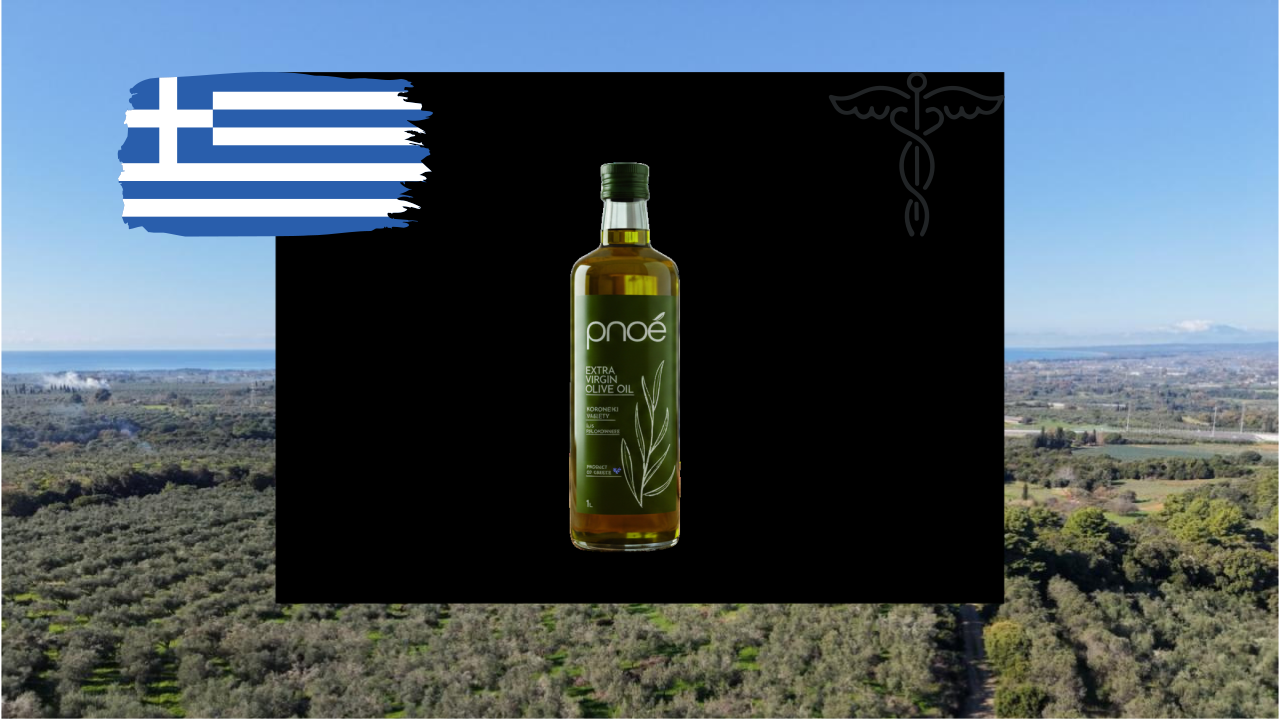
Greece’s “Liquid Gold”
From the Sacred Olive Tree to the Scientific Confirmation of Health Introduction Few products have b